The Cigarette Girl of Mosselprom (1924)

•02/04/2012 • 1 Comment

The Cigarette Girl of Mosselprom

(Papirosnitsa ot Mosselproma) 

Yuliya Solntseva / Igor Ilyinsky / Anna Dmokhovskaya / Nikolai Tsereteli / Leonid Baratov /  Written by  Faiko  & Otsep / Art Direction by  Vladimir  Ballyuzek & Sergei Kozlovsky / Cinematography Yuri Zhelyabuzhsky / Director  Yuri Zhelyabuzhsky

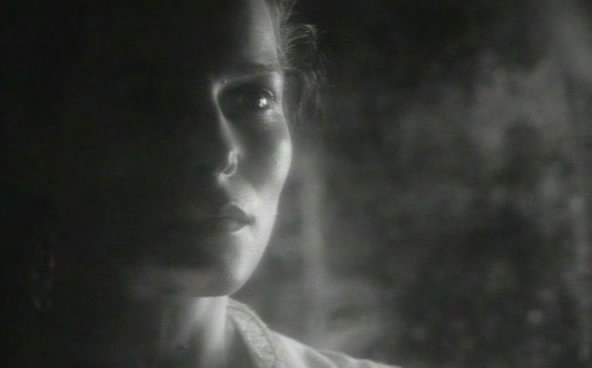
In a refreshing break from the usual heady  fare of the Soviet propaganda machine, Igor Vladimirovich Ilyinsky steps assuredly into Keystone territory, complete with inebriate Chaplin waddle, and Ford Sterling grimaces & gurns. Ilyinsky plays the lovesick Nikodim, who pines away his monotonous office hours living for the stolen moments spent each day on a busy Moscow street corner with beautiful Cigarette vender Yuliya Solntseva. Yulieta (Julieta), she of the Frida Kahlo eyebrows and sparkling realism, is a visual tonic to the senses, a breath of fresh air in the Soviet Silents, reminiscent of Chaplin’s flesh and blood love interest Edna Purviance.  Each day Ilyinsky spends his earnings on buying cigarettes  from his dream girl, with the charmingly sad realization on out part that he doesn’t even smoke.  Naturally this love is unrequited, and to complicate matters, Ilyinsky is perpetually pursued by office dragon lady (Anna Dmokhovskaya), while Yulieta herself  is romanced by smitten cine-cameraman (Nikolai Tsereteli) as he shoots films on the streets of Moscow.

On the surface there is little original in all this, at least nothing to lift it above the usual slapstick fare of the late Hollywood 10′s, but there’s something imperceptibly hypnotizing from beginning to end. It’s partly due to the relaxed and characterful smoothness of  the camerawork, travelling with imperceptible ease around the Moscow streets in a romantic shimmy.. but mostly because of the poetic oddness of the mood created. Yulieta, the Cigarette Girl is drawn inexorably into the role of film star, taking us into further into familiar Keystone territory, breaking the fourth wall to explore the film-making process, and layering artifice upon artifice with a screening of a screening. Not quite a Droste effect, but the possibilities are already forming. Where the film works best is in it’s ability to take it’s time, wander about, meander through delightful little gestures and visual thoughts, in a way that contemporary American films were restricted to fast pace and with a sharper eye on cost of production. Europe took more risks, and let the pot boil a little longer, in hopes that something special would drift to the surface.  

There are a few faded prints out there with tiresome musical accompaniment, so unless you want to spoil your initial experience, I’d advise seeking out the beautifully restored KINO edition. Aside from the surprisingly crisp image, it has an evocative new score with just the right combination of haunting Russian folk music, combined with a charming comic irony. Upon it’s release ‘The Cigarette Girl of Mosselprom’ was greeted with little praise from the Russian critics, who thought it vulgar and far too American in it’s sentimentality, but the general cinema goers were much more enthusiastic. So much so, that Ilyinsky shot to national fame practically overnight, even having a planet named after him. The rather charmingly named ‘3622-Ilyinsky’ still twinkles away up there somewhere. How many other film stars can claim to have been immortalized in the very stars? Yuliya Solntseva herself joined Ilyinski in the heavens when she went on to play ‘Aelita: The Queen of Mars’ in 1924, and eventually became one of Russia’s most respected Directors, in her own right. 


.

.

.

.

.

.

.

.

.

.

.

.

.

.

.

.

.

.

____________________

~COMING SOON : MISS MEND (1926) with the intrepid Natalya Glan~

Valerie and her Week of Wonders (1970)

•15/01/2012 • Leave a Comment

Valerie And Her Week Of Wonders

(Valerie a týden divu)

Jaroslava Schallerová / Helena Anýžová / Karel Engel / Jan Klusák / Petr Kopriva /  Soundtrack  Lubos Fiser  /  Based upon the novel by Vitezslav Nezval / Screenplay  Jaromil Jireš  /  Cinematography  Jan Curík  /  Art Direction  Jan Oliver  /  Set Design  Josef Calta  /  Producer  Jirí Becka  /  Director  Jaromil Jireš

THE JIREZ VISUAL POETRY: Part One

~

~

~

~

~

~

~

~

~

~

~

~

~

~

~~~~~~~

~~~~~

IMAGERY


~

JABBERWOCKY (1977)

•14/12/2011 • 3 Comments

JABBERWOCKY

Michael Palin / Max Wall / Deborah Fallender / John LeMesurier / Harry H. Corbett / Warren Mitchell / Annette Badland / Bernard Bresslaw / John Bird / Rodney Bewes / Neil Innes / Terry Jones / Brian Glover /  Art Direction  Millie Burns  /  Costume Design  Charles Knode & Hazel Pethig  /  Cinematography  Terry Bedford  /  Production  Julian Doyle, John Goldstone & Sanford Lieberson  /  Screenplay  Charles Alverson & Terry Gilliam  /  Director  Terry Gilliam

Terry Gilliam’s Jabberwocky has never really known what it was supposed to be, which considering it was inspired by a Lewis Carroll nonsense poem (from ‘Alice, through the looking glass’) is all quite suitable. That said, it is certainly the most dysfunctional of all Gilliam’s forays into cinema, which is quite an achievement in itself, given the number of capsized projects to fall by the wayside, or  else battered by harsh studio edits. *Von Stroheim shakes a small fist at the heavens, and mutters something unintelligible in German..*

Prior to his present incarnation as Director and all round risk-taking auteur, Terry Gilliam was of course the American, animation guy in that bunch of mighty comic surrealists Monty Python. The Python collective mind (along with Mr.Gilliam comprising of John Cleese, Graham Chapman, Michael Palin, Terry Jones & Eric Idle), was never truly versed in the poetic cinematic eyes and ears of the business, contented to stick to the tried and tested loose structure of linked sketches when tackling their big screen appearances. Both The Life of Brian & The Holy Grail are largely stitched together gags, that either rely upon one unifying character bounding from one scene to the next (Chapman tending to take to the lead) and an even coating of contextual or atmospheric detail, generally the contribution of Gilliam’s fevered imagination and madcap visual referencing.

To stride out from the comfy confines of Python was never going to be a simple task, especially when it necessitated borrowing fellow Pythons Palin & Terry Jones to keep the backers happy. Killing off Jones in the opening sequence helped provide a little distance, and silence any unwanted directorial influence (Jones not only Directed ‘Brian’, but also took the lion share of the Directors chair on ‘Holy Grail’).  Unfortunately Jabberwocky winds up being far closer to ‘Life of Brian’, than I’m sure Gilliam intended, even regurgitating the beggar scene, albeit with a wry twist (Palin looking on in abject horror at a beggar reduced to chopping off his own feet in improve public sympathies).

Where Jabberwocky truly excels is in it’s extraordinary ensemble cast of comedy royalty. Harry H. Corbett (Steptoe & Son) gives one of his last great performances, dodging the wrath of ‘Carry-on’ giant Bernard Bresslaw ,  Warren Mitchell (Alf Garnett) cooks up a delicious role as Mr.Fishfinger, whilst John LeMesurier (Dad’s Army) plays the hilariously camp Lord Chancellor to Max Wall’s blissfully, unstately King Bruno the Questionable.  Curiously what hinders ‘Jabberwocky’ is it’s preoccupation with cramming as much humour in as possible, but at the same time it is that humour which ultimately allows the Period setting to work quite as well as it does. Without the humour we would be left with a series of beautiful visuals, some nice costumes, and very little else.

Every other Gilliam project is characterized by it’s complexity. Jabberwocky is the complete opposite.. which in a way makes it quite fascinating, showing a bare-bones Gilliam, caught with his trouser’s down. er.. that sounds worse than intendid.

With this first stride beyond the Python team, Gilliam is yet to make the transition to wry, emotive humour, wherein the plot progression and depth of his coming films will flourish and graduate. Although, even here we perceive the welcome disorder and mad indulgences that mark the Gilliam personality, and indeed characterize the emergence of the cinematic individual and mark of the auteur. A true offspring of the Romantics, Gilliam quickly seems to have realized the difficulties experienced in transferring to screen an all consuming Mediaevalism combined with such all a breathless comedic pace. Nevertheless contributing to the tradition of Mediaevelism that literature, art  have explored throughout the 19th and 20th Century, from Tennyson’s poetry to William Morris and the PreRaphaelite’s hypnotic art.

In purely cinematic terms, a certain distance, or modern standpoint is required, from which perspective we can observe and remain afloat throughout a realised piece, without losing our way and stewing in the mix. Admittedly we have Michael Palin’s central character attempting to impart a ‘Modern System of Economics’ upon the Mediaeval marketplace, as a sort of pre-cursor to the coming of the ‘so-called’ Age of Enlightenment and Modernity (to be so beautifully explored and despaired at in ‘Baron Munchausen’).. but the wonderful epiphany of equating the past with dreams, and blurring the distinction between fantasy and reality, is yet to take hold. This revelation finds it’s birth in Gilliam’s forthcoming ‘Time Bandits’, before taking full, glorious flight in his Walter Mitty nightmare ‘Brazil’. There is though, something oh, so very attractive about standing on the brink of greatness, and enjoying the birth of a new creative genius in the making. Jabberwocky is fun, crude and chock full of dangerous risks. If only all first directorial projects were as full of freshness and infectious vitality. If you peer over the cartoon horizon at the films end, you can just about make out the glorious shape of things to come.. 

‘Twas brillig, and the slithy toves

Did gyre and gimble in the wabe;

All mimsy were the borogoves,

And the mome raths outgrabe.

“Beware the Jabberwock, my son

The jaws that bite, the claws that catch!

Beware the Jubjub bird, and shun

The frumious Bandersnatch!”

He took his vorpal sword in hand;

Long time the manxome foe he sought—

So rested he by the Tumtum tree,

And stood awhile in thought.

And, as in uffish thought he stood,

The Jabberwock, with eyes of flame,

Came whiffling through the tulgey wood,

And burbled as it came!

One, two! One, two! And through and through

The vorpal blade went snicker-snack!

He left it dead, and with its head

He went galumphing back.

“And hast thou slain the Jabberwock?

Come to my arms, my beamish boy!

O frabjous day! Callooh! Callay!”

He chortled in his joy.

‘Twas brillig, and the slithy toves

Did gyre and gimble in the wabe;

All mimsy were the borogoves,

And the mome raths outgrabe.

‘The Jabberwocky’ from ‘Through the Looking Glass and What Alice Found There’ (1872)

 by Lewis Carroll – Illustration by John Tenniel

—————————

~~

~~

~

The Saragossa Manuscript (1965)

•12/05/2011 • 1 Comment

THE SARAGOSSA MANUSCRIPT

~ Rekopis znaleziony w Saragossie ~

Zbigniew Cybulski / Iga Cembrzyńska / Elżbieta Czyżewska / Gustaw Holoubek / Stanislaw Igar / Joanna Jędryka / Janusz Klosinski / Bogumił Kobiela / Barbara Krafftówna / Jadwiga Krawczyk / Slawomir Lindner / Krzysztof Litwin / Miroslawa Lombardo / Jan Machulski / Zdzislaw Maklakiewicz / Leon Niemczyk / Franciszek Pieczka / Beata Tyszkiewicz / Kazimierz Opalinski / Adam Pawlikowski / From the novel by  Jan Potocki  /  Screenplay by  Tadeusz Kwiatkowski / Soundtrack   Krzysztof Penderecki / Editor  Krystyna Komosińska  /  Directed by  Wojciech Has

When Martin Scorsese took us spiralling down multiple layers of dreams within dreams with ‘Inception’, he knew from the outset that beneath the bottom-most strata, another had already trod that path.. and gone further still. It is perhaps rather apt that The Saragossa Manuscript has managed to remain such a well kept secret over the years. Even with the enthusiastic aid of such bigwig cinemeisters as Scorsese & F.F.Coppola, who battled to get a restoration and DVD transfer (on the somewhat amusingly titled ‘Mr Bongo’ films label), mentioning The Manuscript still generally get’s a shrug in response. Explaining the plot in a succinct sentence or two is pretty difficult, I’ll give you.. and in most of our minds black & white Polish cinema is bundled up with a certain breed of depressive foreign language film that frightens the hell out of English speaking audiences. Which is a crying shame, because in every way it is an equal to it’s contemporaries that sprung from France, Italy and Britain during the 1960′s New Wave. It manages to be both accurate period drama piece, and voice of the modern morality in state of flux. Sinister and dark.. but comical and ironic in equal turn. 

At the risk of adding to The Manuscript’s obscurity, I don’t feel right in unlocking it’s pages, or plundering it’s beautiful complexities. Like a much loved holiday spot, or a favourite painting in a gallery.. some pleasures need be discovered alone. I’ll just give a nudge in the right direction. Quickly, the great beauty Elżbieta Czyżewska has already started her story..

‘Frasquita told her story to Busqueros, he told it to Lopez Suarez, who in turn told it to Señor Avadoro. It’s enough to drive a man crazy.’


‘All these adventures begin simply. The listener thinks it will soon be over, but one story creates another, and then another still.’


‘Something like quotients, which can be divided infinitely.’


‘I’m a Captain of the guard, not a philosopher. Your maths is just dead numbers.’


‘Señor, this zero, plus one, minus one, gave Archimedes and Newton power equal to the Gods.’


‘Very noble men, but what’s the point of it?’


‘We are like blind men lost in the streets of a big city. The streets lead to a goal, but we often return to the same places to get to where we want to be.. I can see a few little streets here, which, as it is now, are going nowhere. New combinations have to be arranged, then the whole will become clear.. because, one cannot invent something that another cannot solve.’


‘I no longer follow.’


‘Then, let’s keep listening..’


…………………………………………………..


****

**

****

**

**

Wild at Heart (1990) -Addendum-

•09/04/2011 • Leave a Comment

WILD AT HEART

Nicolas Cage / Laura Dern / Diane Ladd / Harry Dean Stanton / Willem Dafoe / Isabella Rossellini / Crispin Glover / Sherilyn Fenn / Grave Zabriskie / Freddie Jones / Soundtrack Angelo Badalamenti / Cinematography Frederick Elmes  / Editor Duwayne Dunham  / Producer Steve Golin, Michael Kuhn  / Directed by David Lynch

Unreleased footage : Part 1 – The Red Shoes

‘One of these days the sun’s gonna come up and burn a hole clean through the planet like a giant electrical x-ray.’


~Visions from the Lime-Green Mystery Disc~

Jane Russell: Mean.. Moody.. Magnificent

•21/03/2011 • 2 Comments

Howard Hughes’ – THE OUTLAW (1943)

‘It is blatant, vulgar, prurient.. I wouldn’t have let it pass the censor..’ NEW CHRONICLE-

‘For it’s size and pretentions it is the silliest film I have ever seen. I cannot recall one touch of taste, one single moment of real intelligence..’ -SUNDAY OBSERVER-

‘It’s not the sort of film from the moral standpoint that I would  recommend to young people at all.’ -DAILY WORKER-

‘Jane Russell would have a hard time in matching her acting ability with Donald Duck or Pluto..’ -Ewart Hodgson – THE TIMES-

‘The exciting Miss. Russell is certainly as handsome as her advertisement. Her clear-cut beauty is of the dark, sultry kind. She has slow, slinky movements..’ -THE STAR-

‘Miss. Russell’s costume is considerably more revealing than Miss Lockwoods’ in Wicked lady.’ -DAILY TELEGRAPH-

‘From the moment we see those two great dark eyes staring at us from the blackness of a stable, she is everything that publicity agents claimed for her.’ -Colin Neil Mackay – DAILY EXPRESS-

*            *            *            *            *

..ARTISTIC OPINIONS ON JANE RUSSELL..


*            *            *            *            *

‘Jane is beautiful, voluptuous, and swarthy as a pirate’s daughter.’

*            *            *            *            *

Jane Russell, ideal feminine type, says artist

James Montgomery Flagg, world-famous artist, asked Jane Russell to pose for him. When he had finished he said, “Jane is beautiful, voluptuous, and swarthy as a pirate’s daughter. I am amazed that they have not hacked her down to the usual Hollywood standard, the coat-hanger with lipstick on it. Men like them the way Russell is looking.”

*            *            *            *            *

*            *            *            *            *

‘Full figures.. will make survival possible in an atomic age!’

*            *            *            *            *

*            *            *            *            *

Jane Russell, ideal feminine beauty avers noted doctor

Dr. Henri Victor Nier of California holds that women with full breasts and ample hips always represent the ideal of feminine beauty after wars, and that Doctors have always recognized this biological truth, “now perhaps women will stop dieting and doing all the foolish things that make child-bearing a hazard. Women with full fecund figures, such as that possessed by Jane Russell will make survival possible in an atomic age.”

*            *            *            *            *

*            *            *            *            *

‘Russell’s posture is superb and she walks with a smooth rhythmic step.’

*            *            *            *            *

*            *            *            *            *

Famous Fashion Designer hails Jane’s superb posture

Jack Perkins, well-known American Fashion Designer, says that it is not enough to wear beautiful clothes on a graceless, slouching girl. They look dismal and unattractive. Jane Russell’s posture is superb and she walks with a smooth rhythmic step. She plays tennis regularly and swims and her advice to other girls is to play hard and be smart.”

*            *            *            *            *

*            *            *            *            *

‘Ideally proportioned and an inspiration for a Sculptor..’

*            *            *            *            *

Jane’s figure is inspiration for Sculptor

Chaim Gross, Famous New York Sculptor, admired the youthful and luscious curves of the young actress so much that he asked Howard Hughes to allow her to pose for him. “She has a marvellous figure, ideally proportioned and an inspiration for a Sculptor. The contours of her bust and shoulder-line are perfect, firmly moulded and fluent in outline whatever pose she takes. The most wonderful model for a picture typifying young womanhood.”

*            *            *            *            *

*            *            *            *            *

*            *            *            *            *

‘Her lips are beautifully moulded and softly appealing.’

*            *            *            *            *

*            *            *            *            *

“Jane Russell has the most kissable lips in the world..”

Said William Earl Singer when choosing Jane as the model for his canvas “An Exciting Girl.” Her lips are beautifully moulded and softly appealing. A combination of youth, beauty and sex appeal and the complete absence of artificial or actressy’ traits make her the ideal exciting girl.” Singer has painted the portraits of Gertrude Lawrence, Vivien Leigh, King Albert of Belgium, King Gustav of Sweden, Duke of Windsor and Greta Garbo amongst others.

*            *

~Quotes originally published in ‘The Triumph of Jane Russell’, Marchwood Press (1951)~

*

*

—————————-

~ DEDICATED TO THE IRREPLACEABLE JANE RUSSELL ~

(1921-2011)

*

Gun Crazy (1950)

•17/03/2011 • 1 Comment

GUN CRAZY (DEADLY IS THE FEMALE)

Notorious LAURIE STARR! Nothing deadlier is known to man..

Peggy Cummins / John Dall / Berry Kroeger / Morris Carnovsky / Anabel Shaw / Harry Lewis / Nedrick Young / Mickey Little / Russ Tamblyn / Screenplay Millard Kaufman (Dalton Tumblo) & McKinlay Kantor  / Production Design Gordon Wiles / Original Music Victor Young  / Cinematography Russell Harlan  / Stunts Dale Van Sickel  / Production Frank King & Maurice King  / Director Joseph H. Lewis

LULU GOES WEST

Never has the gun been so reverentially mythologised as in the hallowed light and shadow play of Film Noir, and none so erotically centre stage as in Dalton Tumblo’s short story turned motion picture, ‘Gun Crazy’, aka. Deadly is the Female. The female in question is the hypnotic Peggy Cummins, playing Laurie Starr, a carnival gunslinger extraordinaire who en-flames the desires and passions of small town gun obsessive, Barton Tare (John Dall),  blazing a trail of drive-by robberies, and shootings from State to State, that can have but one self-destructive outcome. Arthur Penn’s 1967 movie of the Bonnie and Clyde story borrowed extensively from it’s gun-totting predecessor, taking special notice of it’s loose naturalistic cinematography style, and most clearly of all, the sexuality of the relationship on-the-run.

In both stories, this sexuality oscillates from the couple (for Bonnie a frustration that is achingly one sided), to the erotic thrill of the danger ride, which in this case specifically surrounds ‘the gun’, as instrument of power and freedom. Initially, Barton struggles as a youth with his desire to possess and fire guns, trapped in a confusingly fractured  adolescence that seeks something fundamental to being, without knowing quite what it is that is desired. ‘Girls!’, the audience cries.. ‘He just needs to meet a nice girl!’ Almost right, he needs to meet a ‘Bad-girl’. When encountering the almost preternatural beauty Laurie Starr, time seems to slow to a silent pause when their eyes first meet.. something hangs in the air.. and the explosion of a pistol direct to camera marks the union  (albeit a blank). In one instant, both Barton and we ourselves, are hopelessly smitten. His rationale of this joining places the two of them into two clear aspects of the gun: weapon and bullet – “We go together, Annie. I don’t know why.. maybe like guns and ammunition go together.”

Personally, I’m thinking it makes more sense to consider Laurie as the gun and powder complete. What our protagonist has sought all his life is the Noir Fatale. Stealing a pistol as a boy, entering the army (surrounded by guns of every description), collecting antique pistols.. did not cure his thirst for the ‘fire of the hand’. The gun’s cold precision and aim alone was not enough, he needed the elemental wild fire in the explosion. The Femme-Fatale in her pure, unadulterated form, as incandescent raw sexuality, wrapped up in excitement and death. Very Catholic. okay, chalk up another victory for Mr.Freud.. it’s all desire and symbolic ejaculations!

‘These violent delights have violent ends
And in their triumph die, like fire and powder,
Which, as they kiss, consume. The sweetest honey
Is loathsome in it’s own deliciousness
And in the taste confounds the appetite.
Therefore love moderately: long love doth so;
Too swift arrives as tardy as too slow.’

Romeo and Juliet | Act II, Scene VI

What? I hear you cry? Woman cast once more in the role of wicked Lulu, a siren torment to hapless man? Dancing unconcerned in a blaze of glory, whilst all around her burn? Peripheral female characters just spinsters or exhausted mothers tied to the stove?  Yup. Don’t be too harsh though (he urges his readers), six decades have passed, and it is, after all, just a movie. Did I really just utter that much disliked phrase? (I’ll stop with the over-accumulation of question marks now). Besides, it’s all character exaggeration, violent symbolism, and lurid sexual exploration (nee, exploitation), y’know.. Film Noir.


‘And now, our great Star-Act. Ladies and gentlemen, as owner and manager of Packett’s Carnival, it is I, myself, who present to you.. The Famous. The Dangerous. The Beautiful.. Miss. Annie Laurie Starr..’

‘..direct from London, England and the capitals of the Continent, before whose remarkable marksmanship the greatest pistol and rifle-shots in America have gone down to defeat. Sooo.. here she is, ladies and gentlemen. Sooo appealing. Sooo dangerous. Sooo looovely to look at. The darling of London, England.. Miss. Annie Laurie Starr!’

‘I saw the two of you, the way you were looking at each other tonight, like a couple of wild animals. Almost scared me.’

‘..she ain’t the type that makes a happy home.’

‘Here am I, mad about you, mad about you
I can’t lie, I’m mad about you, mad about you,
Though I said to my heart, don’t fall.
How I love the enchantment of it all,
If you knew all the dreams I’ve had about you,
Then you’d know that I’ve got it bad about you,
Press your lips to my lips and hold me near, so near,
Can’t you see I’m mad about you, dear.

If you knew all those dreams I’ve had about you,
Then you’d know that I’ve got it bad about you,
Press your lips to my lips and hold me near, so near,
Settle down, you, gadabout*, you,
Please don’t make me sad about you,
Can’t you see I’m mad about you, dear.’

~Victor Young~

———————————————

———————————————

PEGGY CUMMINS (b. 18th Dec. 1925 – Denbighshire, Wales)

‘Notorious LAURIE STARR! …wanted in a dozen states… hunted by the F.B.I.!’


Her Violent Loves! Her Vicious Crimes! Her Wild Escapes!’

——-